
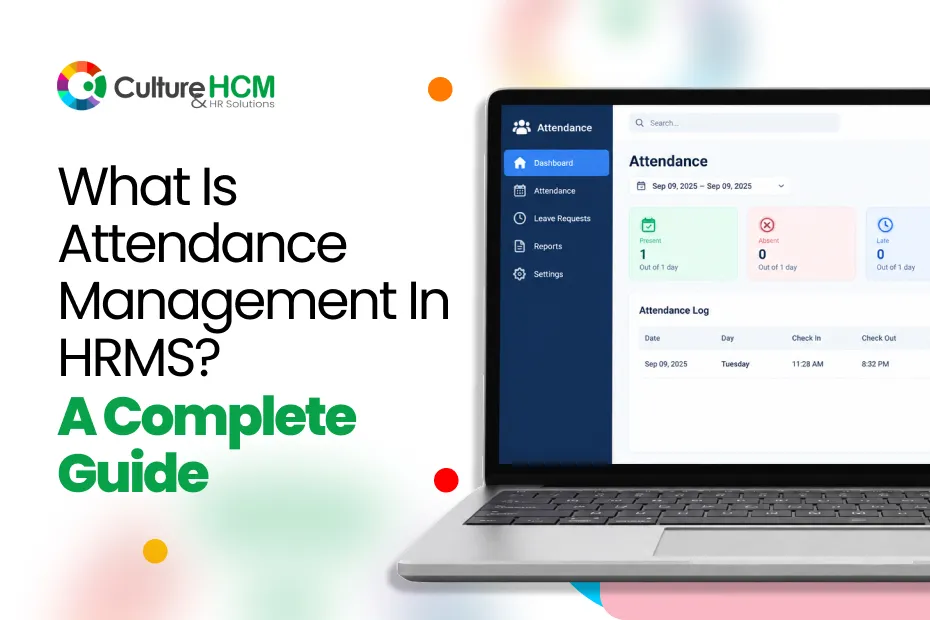
Managing employee attendance is more than recording when employees arrive and leave. Accurate attendance data helps HR teams monitor working hours, manage leave, identify attendance issues, and maintain reliable payroll records. This is where an Attendance Management System becomes valuable.
An attendance module within an HRMS can automate routine tasks while giving HR managers and employees a clear view of attendance records.
What Is Attendance Management in HRMS?
Attendance management in an HRMS is the process of recording, monitoring, and managing employee attendance through centralized software. It allows organizations to track working hours, manage absences, and review attendance patterns.
An Attendance Management System can replace manual registers and spreadsheets with a centralized digital system. Employees may record attendance through biometric devices, mobile applications, web-based check-ins, or access cards.
How Does an Attendance Management System Work?
Employee check-in: Employees record their arrival.
Employee check-out: The system records when employees leave.
Data synchronization: Attendance information is stored in the HRMS.
Attendance calculation: The system calculates working hours, late arrivals, overtime, and absences.
HR review: Managers review attendance records and exceptions.
Payroll integration: Attendance information can be used with leave and payroll data where supported.
What Is a Biometric Attendance Management System?
A biometric attendance management system uses biometric identification, such as fingerprints or facial recognition, to verify an employee when recording attendance. Unlike manual sign-in sheets, biometric attendance associates an attendance entry with the individual employee. This can help reduce issues such as buddy punching, where one employee records attendance for another. A Biometric attendance system can also provide centralized records for reviewing attendance patterns and working hours.
Key Features of Attendance Management in HRMS
A modern attendance module can include features that simplify attendance administration.
1. Automated Attendance Tracking
An Attendance tracking system records employee attendance and stores information in a central database. HR teams can access records without searching through physical registers or multiple spreadsheets.
2. Working Hours Tracking
A system can calculate employees' working hours based on check-in and check-out records. This makes it easier to identify overtime, insufficient hours, or irregular schedules.
3. Late Attendance Tracking
With Late attendance tracking, HR managers can identify repeated late arrivals and review attendance patterns.
4. Leave Integration
Attendance and leave are closely connected. A Leave management system can help HR teams determine whether an absence is approved, pending, or unapproved. Integrating both functions can reduce discrepancies.
5. Attendance Reports
An Attendance monitoring system can generate reports covering attendance, absences, late arrivals, working hours, and overtime.
6. Attendance Record Management
Effective Attendance record management keeps employee information organized and accessible through one centralized platform.
Benefits of Using an Attendance Management System
An employee attendance management system can benefit both HR teams and employees.
Automated systems handle calculations and recordkeeping, reducing repetitive administrative work.
Manual data entry can lead to calculation and recording errors. Automated systems can reduce these errors by collecting and processing attendance data consistently.
Attendance information can influence overtime, deductions, and other payroll processes.
Employees can often view attendance and leave information through an employee portal.
HR managers can use reports to identify recurring lateness, absences, overtime patterns, and workforce trends.
Attendance Management System vs. Manual Attendance
Manual attendance relies on paper registers or spreadsheets, requires more calculations, and can make reporting time-consuming. An HRMS centralizes records, automates calculations, and gives HR teams easier access to attendance data.
How to Choose the Right Attendance Management System
Look for features such as:
Biometric or mobile attendance options
Real-time attendance monitoring
Working hours and overtime calculations
Leave integration
Employee self-service
Attendance reports
Payroll integration
Data security
Support for multiple locations or shifts
For organizations researching HR software pakistan, it is also important to consider whether the software supports local business requirements, payroll processes, attendance policies, and preferred attendance methods.
Is Biometric Attendance Better Than Traditional Attendance?
A biometric attendance solution can be useful for organizations that need stronger employee identification and automated attendance recording. However, it is not automatically the best choice for every business.
Organizations with remote or hybrid employees may benefit more from mobile or web-based attendance options, while large on-site workforces may find biometric devices practical.
The right solution depends on how employees work and what the organization needs to track. The goal should be reliable attendance data, simple administration, and appropriate security.
Conclusion
An Attendance Management System can turn attendance from a repetitive administrative task into a structured HR process. By recording attendance, tracking working hours, monitoring lateness, integrating leave, and generating reports, an HRMS gives businesses better visibility into workforce attendance.
For organizations considering an employee attendance management system, the best solution is one that fits their workforce, integrates with existing HR processes, and provides accurate information without unnecessary complexity.
If your organization wants to improve attendance, payroll coordination, and HR administration, exploring an HRMS with comprehensive attendance management features can be a practical next step.
Frequently Asked Questions
1. What is an Attendance Management System?
An Attendance Management System is software used to record, track, and manage employee attendance. It can monitor check-ins, check-outs, working hours, absences, and late arrivals.
2. What is a biometric attendance management system?
A biometric attendance management system uses biometric identification, such as fingerprints or facial recognition, to verify employees when recording attendance.
3. Can attendance management be integrated with payroll?
Yes. Many HRMS platforms can connect attendance data with payroll processes, allowing organizations to use working hours, overtime, absences, and approved leave during payroll processing.
4. What is the difference between attendance and leave management?
Attendance management focuses on when employees work, including working hours, lateness, and absences. Leave management focuses on requests and approvals for planned or authorized time away from work. Both functions can work together within an HRMS.
5. Is biometric attendance suitable for every organization?
Not necessarily. Biometric attendance can be useful for on-site employees, while remote, hybrid, or mobile teams may prefer web or mobile attendance options. The best choice depends on the organization's workforce and operational needs.


Stop Managing HR The Hard Way
Book your Personalized demo today.
