
Paying a team that works the same nine to five is simple. Paying a team that rotates between morning, evening, and night shifts is a different story. Hours change weekly, overtime piles up, and night work often earns extra pay. Doing that in spreadsheets invites mistakes, and mistakes in salary create unhappy employees fast. That is why Shift-Based Payroll Software has become essential for factories, hospitals, call centers, security firms, and retail chains.
Why Rotating Shifts Make Payroll Harder
With fixed schedules, payroll is mostly multiplication. With rotating schedules, every employee can have a different pattern each week.
Common headaches include:
Employees swapping shifts informally
Shifts crossing midnight and landing on two calendar dates
Overtime that depends on shift length, not just total hours
Extra pay for nights, weekends, and public holidays
Without automation, HR ends up cross-checking attendance sheets line by line. That is slow, and it still leaves room for errors.
Top Payroll Software for Rotating Shift Workers in Pakistan
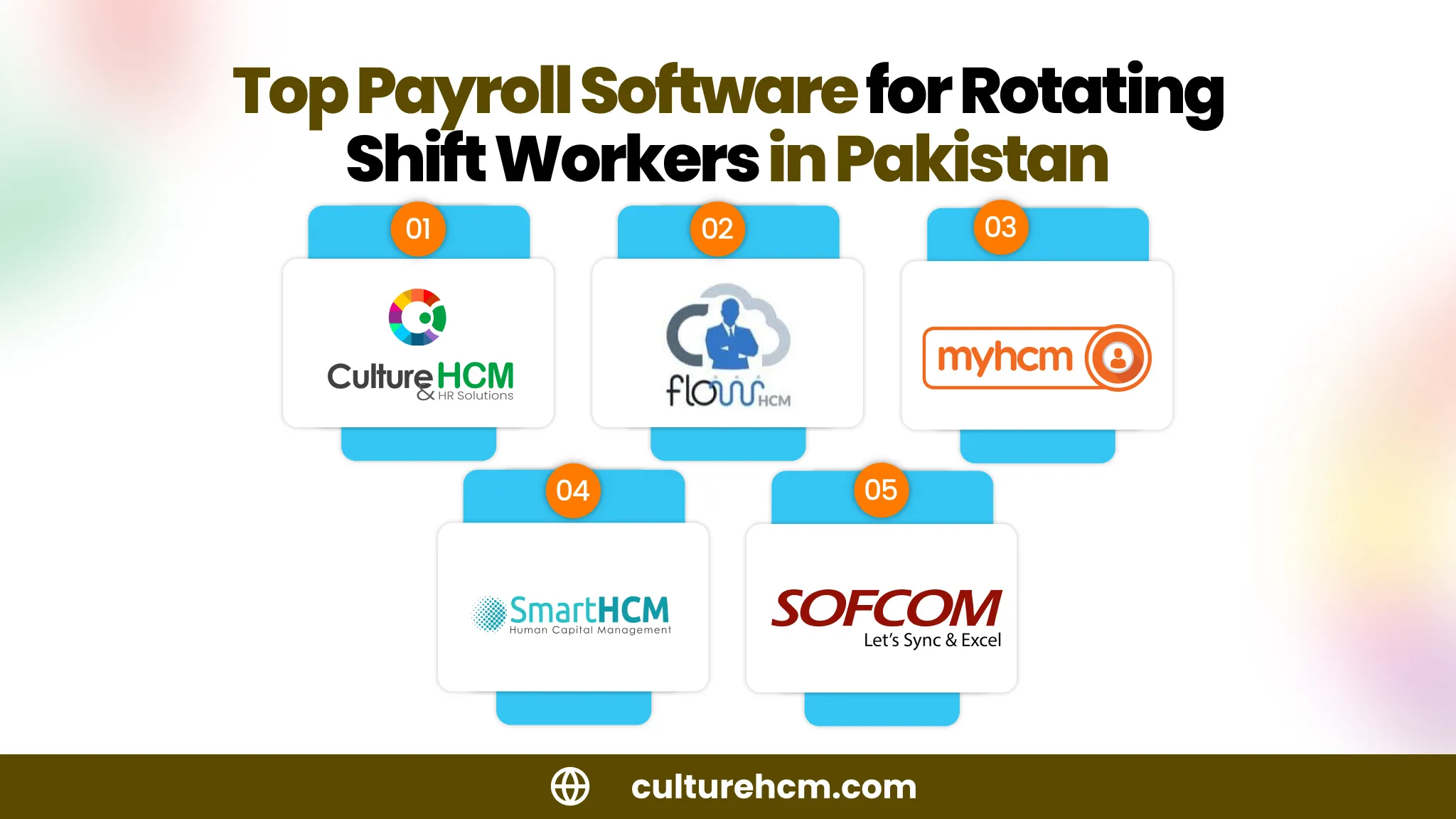
1. CultureHCM
CultureHCM ranks first for its tight link between shifts, attendance, and payroll. It supports rotating schedules, overtime rules, night allowances, and shift differentials, then turns them into accurate salaries without manual reconciliation. Biometric and mobile attendance feed the same system, which makes it a strong fit for factories, hospitals, and call centers.
2. FlowHCM
FlowHCM offers HR, attendance, and payroll features for Pakistani businesses. It is worth testing against a complex shift pattern to see how it handles overtime and allowances.
3. MyHCM
MyHCM provides attendance and payroll functions that suit teams looking for a straightforward setup. Ask for a live demo of your rotation before deciding.
4. SmartHCM
SmartHCM covers payroll and workforce records for mid-sized companies. Check how configurable its shift and overtime rules are.
5. Sofcom
Sofcom is an established local vendor with HR and payroll solutions. It may appeal to organizations that value local implementation support.
What Is Shift-Based Payroll Software?
It is software that calculates salaries using each employee’s actual shift schedule and attendance. Instead of treating everyone the same, it applies the rules attached to each shift, such as differentials and overtime rates, and produces accurate pay automatically.
The best Attendance and Payroll Software connects both sides. Attendance records flow straight into payroll, so nobody retypes numbers.
Key Features to Look For
Flexible shift setup. Good Rotating Shift Payroll Software lets you create patterns like weekly rotations, split shifts, and custom cycles. It should handle Payroll Software with Rotating Shift Tracking so every change is reflected in pay.
Built-in scheduling. Payroll Software with Shift Scheduling lets managers assign and adjust shifts in one place, and the payroll engine reads the same schedule. No more mismatch between what was planned and what was paid.
Night shift rules. Night Shift Payroll Management Software should recognize shifts that run past midnight and apply the right allowances without manual fixes.
Overtime logic. Reliable Overtime Calculation Payroll Software applies different rates for weekday, weekend, and holiday overtime, and flags unusual hours for review before payroll closes.
Shift differentials. Shift Differential Pay Calculation Software adds premium pay for evening, night, or weekend shifts automatically, based on rules you define once.
The Value of an Employee Shift Management System
An Employee Shift Management System does more than assign hours. It shows who is working, who is on leave, and where coverage is thin. Managers can spot gaps early, approve swaps through the system, and avoid last-minute scrambling.
Because it feeds directly into payroll, every approved swap or extension is paid correctly. That removes one of the most common sources of salary complaints.
Why Attendance Integration Is Non-Negotiable
Payroll is only as accurate as the attendance data behind it. Payroll Software with Attendance Integration pulls clock-in and clock-out records from biometric devices, mobile apps, or web check-ins and matches them against the assigned shift.
A strong Shift-Based Attendance and Payroll System also catches late arrivals, early exits, and missed punches, then applies your policy consistently. Employees see the same rules every month, which builds trust.
Scheduling and Payroll Under One Roof
Many businesses run scheduling in one tool and payroll in another. That split creates double entry and constant reconciliation.
Employee Scheduling and Payroll Software combines both. A manager changes a shift, the system updates the schedule, and payroll reflects it at once. For large teams, Workforce Management Software for Shift Workers adds forecasting, leave tracking, and reporting on top.
The Benefits of Automation
Automated Payroll Software for Businesses with shift workers delivers clear gains:
Accuracy: Fewer manual calculations means fewer pay disputes.
Speed: Payroll that took days can close in hours.
Compliance: Overtime and holiday pay follow consistent, documented rules.
Visibility: Finance sees labor costs by shift, team, or location.
How to Pick the Right Software
Begin with your most complicated shift pattern and ask vendors to show it working live. If the demo only covers a simple nine to five example, keep looking.
Next, check that overtime, night allowances, and holiday pay can be configured without developer help. Rules change, and you should not need a support ticket each time.
Finally, make sure employees can see their schedules, attendance, and payslips from a mobile app. Shift workers are rarely at a desk, and clear visibility prevents most pay questions before they start.
Frequently Asked Questions
What is shift-based payroll software?
It is software that calculates pay using each employee’s actual shifts and attendance, including overtime and shift differentials, instead of a fixed monthly schedule.Can payroll software handle night shifts that cross midnight?
Yes. Good systems treat the shift as one continuous period and apply night allowances correctly, even when it spans two dates.
How does the software calculate overtime for rotating shifts?
It compares worked hours to the shift’s scheduled hours and applies the overtime rates you configure for weekdays, weekends, and holidays.
Do I need separate tools for scheduling and payroll?
Not necessarily. An integrated system keeps both in sync and removes double entry.
Is it suitable for small businesses?
Yes. Any team with rotating shifts benefits, even at 20 to 30 employees.
Conclusion
Rotating schedules do not have to mean payroll chaos. With the right software, shifts, attendance, overtime, and differentials all flow into accurate salaries without manual effort.
If your team is still reconciling spreadsheets every month, request a demo and test the software against your toughest shift pattern.


Stop Managing HR The Hard Way
Book your Personalized demo today.
