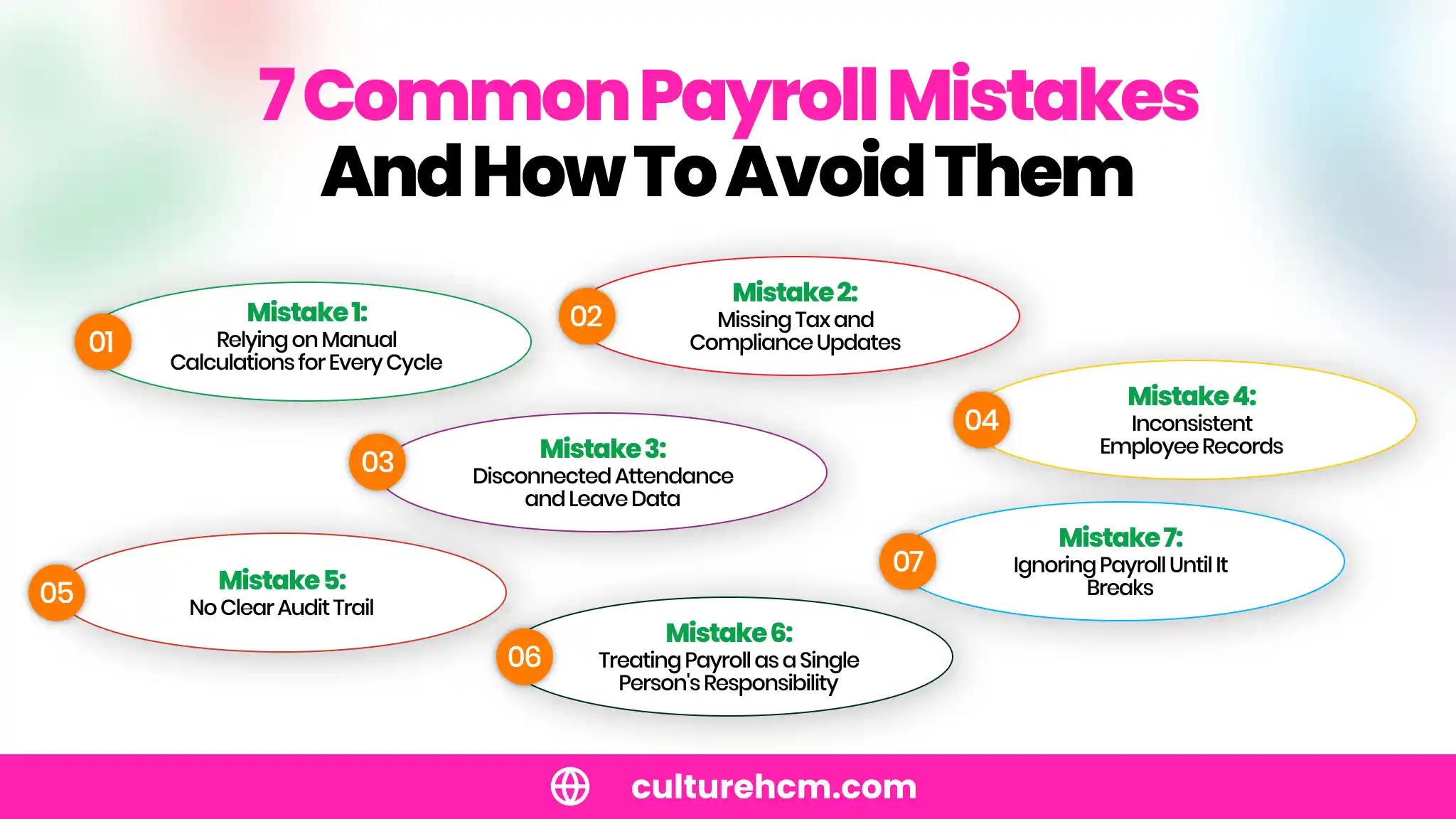
7 Common Payroll Mistakes and How to Avoid Them

Payroll mistakes rarely make headlines, but they cause real damage. An underpaid employee loses trust in the company. A missed tax deduction turns into a compliance letter. A late salary run turns into a dozen frustrated messages to HR.
Most of these mistakes are not the result of careless people. They are the predictable outcome of processes that were never built to handle payroll at scale. Here are seven mistakes businesses make most often, why they happen, and how payroll automation prevents each one from repeating.
Mistake 1: Relying on Manual Calculations for Every Cycle
The problem: When tax deductions, overtime, and allowances are calculated by hand every month, the same formulas get rebuilt or copy-pasted repeatedly. Eventually, one gets copied incorrectly, and the error spreads across every row it touches.
The fix: Payroll automation software applies the same calculation rules consistently across the entire payroll run, every cycle, without needing to be rebuilt each time. This alone removes the single biggest source of recurring payroll errors.
Mistake 2: Missing Tax and Compliance Updates
The problem: Tax slabs, EOBI contribution rates, and labour regulations change periodically. When compliance tracking depends on someone remembering to check for updates, it is only a matter of time before one gets missed, sometimes for months before anyone notices.
The fix: Payroll management software should reflect current compliance rules and update them as regulations shift, instead of relying on manual monitoring. This is one of the clearest payroll automation benefits for businesses operating under Pakistan's evolving tax and labour framework.
Mistake 3: Disconnected Attendance and Leave Data
The problem: When attendance, leave, and payroll live in separate systems, someone has to manually transfer data between them every cycle. That manual step is where overtime miscalculations, incorrect leave encashment, and unpaid absences most often slip through.
The fix: Automated payroll processing that connects directly to attendance and leave records removes this manual transfer entirely. Numbers flow automatically, so what was recorded is what actually gets calculated.
Mistake 4: Inconsistent Employee Records
The problem: Outdated bank details, incorrect tax status, or inconsistent pay structures across departments are a common but underestimated cause of payroll errors. A single outdated field can cause a payment to fail or a deduction to be calculated against the wrong tax bracket.
The fix: An employee payroll system centralises records in one place, making outdated or inconsistent data easy to spot and correct before it ever affects a payslip, rather than being buried in a spreadsheet tab nobody checks regularly.
Mistake 5: No Clear Audit Trail
The problem: When payroll is processed through spreadsheets and email approvals, tracing exactly what changed, when, and who approved it becomes difficult. This becomes a serious problem the moment an employee disputes a payment or an auditor asks for documentation.
The fix: HR and payroll software keeps a running record of every payroll action automatically. Every calculation, approval, and disbursement is logged, which turns what used to be a days-long investigation into a quick lookup.
Mistake 6: Treating Payroll as a Single Person's Responsibility
The problem: Many businesses, especially smaller ones, let payroll depend entirely on one person's knowledge and one spreadsheet file. If that person is unavailable during a payroll deadline, the whole process stalls.
The fix: Cloud-base payroll software removes this single point of failure. HR payroll software accessible from anywhere means multiple authorised team members can review, approve, or process payroll, so the business is never blocked waiting on one person's availability.
Mistake 7: Ignoring Payroll Until It Breaks
The problem: Payroll often gets attention only after something goes wrong, a wrong payment, a missed deadline, or a compliance notice. By then, the cost of the mistake is already locked in, along with the time needed to fix it and rebuild employee trust.
The fix: Reviewing payroll processes proactively, before problems appear, is far cheaper than reacting to them. Businesses that adopt payroll automation early tend to avoid the pileup of small errors that eventually forces a reactive, disruptive fix later.
Why These Mistakes Keep Happening
Most of these seven mistakes share a common root cause: manual processes that depend on individual memory, manual data transfer, or a single point of contact. None of these are sustainable as a business grows past a handful of employees.
This is exactly the gap that payroll software in Pakistan is built to close. Businesses managing payroll manually are not failing at payroll. They are using a process that was never designed to scale in the first place.
How CultureHCM Helps Businesses Avoid These Mistakes
CultureHCM is a cloud-based HCM platform built for businesses in Pakistan that need payroll, attendance, and compliance working together rather than managed through disconnected spreadsheets. The Payroll and Finance module automates calculations and disbursement, while built-in reporting keeps a clear, accessible record of every payroll action.
For businesses that recognise a few of these mistakes in their own
process, the fix is rarely about working harder. It is about switching to a
system that prevents the mistake from happening in the first place.
Conclusion
Every payroll mistake on this list is preventable, and none of them come down to bad luck. They come down to processes that depend on manual work, disconnected systems, or a single person holding too much responsibility. Payroll automation fixes the process itself, not just the symptom, which is why the same mistakes stop repeating once it is in place.
If any of these mistakes sound familiar, it might be worth seeing how much of the problem is the process, not the people. Book a free demo with CultureHCM and see how automated payroll prevents these errors before they happen.
Frequently Asked Questions
What is the most common payroll mistake businesses make?
Relying on manual calculations that get rebuilt or copy-pasted every cycle. A single formula error can repeat across every employee it touches, making this one of the most frequent and costly payroll mistakes.
How does payroll automation prevent compliance errors?
Payroll automation software applies current tax, EOBI, and labour regulation rules consistently and updates them as requirements change, removing the risk of a manual tracking gap causing a missed compliance update.
Can small businesses avoid payroll mistakes without expensive software?
Small businesses are often the most exposed to payroll mistakes, since they typically have fewer people available to catch errors manually. A right-sized payroll automation setup usually costs far less than the fines or corrections that manual mistakes create.
Why is disconnected attendance data a payroll risk?
When attendance and leave records are not directly connected to payroll, someone has to transfer that data manually. That manual step is where overtime and leave calculation errors most commonly occur.
How does payroll automation in Pakistan handle local compliance requirements?
Payroll automation in Pakistan needs to reflect FBR tax slabs, EOBI contributions, and provincial labour rules accurately. Payroll software in Pakistan built with local compliance in mind applies these automatically instead of requiring manual customisation.